


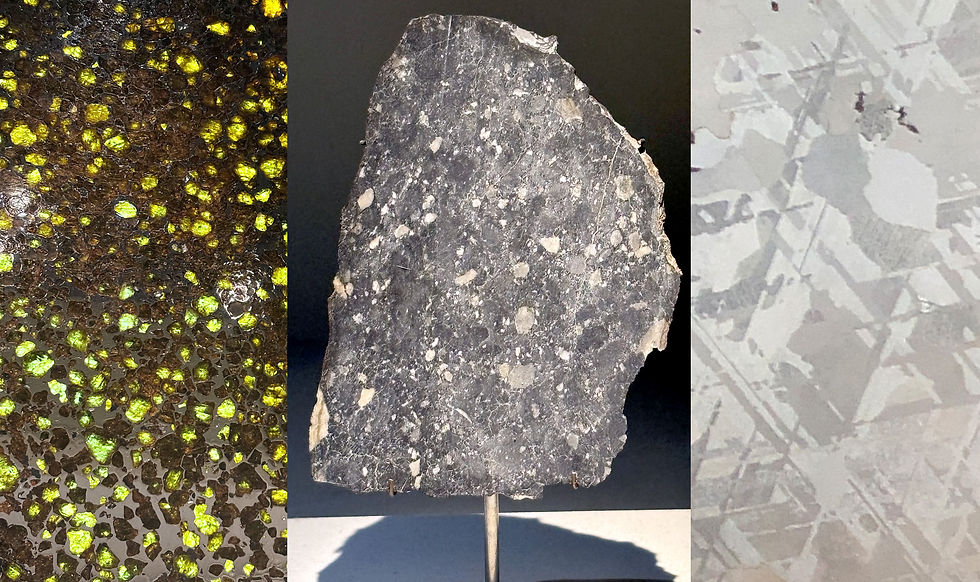
Image: S.Hetherington (NHM London collection)
Meteorite Types Overview
Chondrites | Achondrites | SNC group | HED group | Irons | Stony-irons
Approximately 40,000 tonnes of extraterrestrial material fall to Earth’s surface each year. These objects, known as meteoroids, enter the atmosphere at speeds of 20–70 kilometres per second and range in size from tiny dust grains to bodies many metres across. Friction with the atmosphere rapidly heats them to thousands of degrees Celsius. At this stage they are called meteors: smaller ones appear as shooting stars, while larger ones can produce spectacular fireballs.
Any body the size of a pebble or larger will at least partially survive atmospheric entry and reach the ground as a meteorite. Meteorites fall roughly evenly across Earth’s surface, with a slight preference for equatorial latitudes. The Antarctic ice sheet and arid deserts preserve them especially well, making these regions excellent places to find them. This document provides an overview of meteorite classification. For each type, it offers a concise description of its formation, appearance, and mineral composition.